The Complete USA Buyer’s Guide For Rent-To-Own Metal Garages [2026]
![The Complete USA Buyer's Guide For Rent-To-Own Metal Garages [2026]](https://storage.googleapis.com/stateless-vikingsteelstructure/2026/05/927f5d05-the-complete-usa-buyers-guide-for-rent-to-own-metal-garages-2026.webp "The Complete USA Buyer’s Guide For Rent-To-Own Metal Garages [2026]") Published On:
Published On: Most Americans don’t have $8,000 to $20,000 sitting in a savings account waiting to be spent on a steel garage. But they do have $200 to $400 a month — and that’s exactly the gap rent-to-own programs were designed to close.
Over the last few years, rent-to-own metal garages have shifted from a niche option to one of the most common ways US homeowners, farmers, and small businesses are putting roofs over their vehicles, equipment, and tools. The reason is simple: rising steel prices made garages more expensive at the same time interest rates pushed traditional financing further out of reach. Rent-to-own filled the void with a model that requires no bank, no credit check, and no large deposit up front.
If you’ve been searching “metal garage rent to own” or “rent to own steel buildings near me,” this guide walks through everything that actually matters: how the program works, what realistic monthly payments look like, who qualifies, and how to use the Viking Steel Structures Rent-To-Own Calculator to lock in a number you can plan around.
What Is a Rent-To-Own Metal Garage?
A rent-to-own metal garage is a steel building you take possession of immediately, then pay off in fixed monthly installments until ownership transfers fully to you. There’s no bank involved, no credit application in most cases, and no waiting weeks for approval. You make a small initial payment, the building is delivered and installed at your property, and you continue making monthly payments for a defined term — usually 24, 36, 48, or 60 months — until the structure is yours outright.
The model is sometimes called lease-to-own, rent-to-buy, or no-credit-check metal building financing, but the mechanics are essentially identical. You’re using your own property as the installation site while paying down the cost of the building over time.
What makes it different from a traditional loan is the underlying agreement. With financing, the bank owns the loan and the building is collateral. With rent-to-own, you’re entering a lease agreement with the manufacturer or its RTO partner. That distinction is what allows providers to skip credit checks and approve buyers in minutes rather than weeks.
How Rent-To-Own Metal Garage Programs Work
The process is genuinely simple, which is part of why it’s so popular. Here’s how a typical program — including ours — moves from inquiry to ownership.
Step 1: Design your garage. You choose the size, roof style, color, gauge, and any custom features (windows, walk-in doors, garage doors, insulation). The total purchase price is calculated.
Step 2: Pick your term. Most programs offer 24, 36, 48, or 60-month terms. Shorter terms mean higher monthly payments but a lower total cost. Longer terms reduce your monthly outlay but slightly increase the total paid over the life of the agreement.
Step 3: Make your initial payment. This is typically the equivalent of the first month’s payment plus tax. There’s no traditional “down payment” of 10–20% like you’d see with a bank loan.
Step 4: Delivery and installation. Once your initial payment clears, your garage is scheduled for delivery. Most installations are completed within 2–6 weeks of order, and the install itself takes a single day for standard sizes.
Step 5: Make monthly payments. Payments are auto-drafted or sent monthly. You use the building immediately — there’s no waiting until it’s “paid off.”
Step 6: Ownership transfers. Once your final payment clears, the title transfers and the garage is fully yours. Most programs also include an early-payoff option that lets you settle the balance ahead of schedule, often with a discount on remaining lease payments.
That’s the entire flow. No appraisals, no lender calls, no closing paperwork.
Benefits of Rent-To-Own Metal Garages
The reason RTO has taken off in the USA isn’t marketing — it’s the actual structure of the program. Here’s what makes it work for real buyers.
- No large upfront payment: Traditional financing often demands 10–20% down, plus origination fees. RTO typically requires only the first month’s payment to get started.
- No credit check on most programs: This alone has made rent-to-own metal garages the most accessible option for buyers with thin credit files, past bankruptcies, or self-employed income that’s hard to document.
- Fast approval: Most applications are reviewed and approved within an hour. You can have a garage on the schedule by the end of the same day you applied.
- Flexible terms: Choose the term that fits your monthly budget. Need lower payments? Stretch to 60 months. Want to own faster? Pick 24.
- Build equity in real property: Every payment moves you closer to outright ownership of a structure that adds value to your land.
- Immediate installation: You don’t have to wait for ownership to use the building. The garage goes up, you start using it, and you pay for it as you go.
- No prepayment penalties: Most providers — Viking included — let you pay off early without fees, often with discounts on remaining lease payments.
For most buyers, the practical benefit comes down to this: you get the garage now, on terms you can actually afford, without putting your savings on the line or waiting on a bank.

Rent-To-Own vs Traditional Financing: The Honest Comparison
Both options have a place. The right one depends on your credit profile, how much cash you have available, and how quickly you need the building. Here’s how they actually compare:
| Feature | Rent-To-Own | Traditional Financing |
|---|---|---|
| Credit Check | Usually none | Required (typically 650+ score) |
| Approval Time | Same day | 1–3 weeks |
| Down Payment | First month’s payment only | 10–20% of total cost |
| Monthly Cost | Slightly higher per dollar financed | Lower if you qualify for prime rates |
| Total Cost Over Term | Higher than cash purchase | Higher than cash, lower than RTO at prime rates |
| Ownership | Transfers at end of term | Immediate (with lien) |
| Early Payoff | Allowed, often with discount | Allowed, sometimes with prepayment penalty |
| Installation Timing | Immediate | Immediate |
| Best For | Buyers without strong credit or cash | Buyers with strong credit and patience |
The takeaway: if you have an 800 credit score and money for a 20% down payment, traditional financing will save you money. If you don’t, rent-to-own gets you the same garage on the same property with dramatically less friction.
Who Should Consider Rent-To-Own Metal Garages?
Rent-to-own isn’t right for everyone, but it’s an excellent fit for several types of buyers we work with every week.
Homeowners protecting vehicles and tools. A two-car garage that costs $9,000 outright becomes $200–$280 a month. For most households, that’s far more digestible than draining the emergency fund.
Rural property owners and farmers. Equipment storage is non-negotiable on a working property. RTO lets you put up a 30×40 or 40×60 building without disrupting cash flow tied up in livestock, seed, or equipment.
RV owners. A 14-foot tall RV garage built for a Class A motorhome can run $15,000–$30,000. Stretched over 48–60 months of rent-to-own, that becomes a manageable line item rather than a major capital expense.
Small business owners. Contractors, landscapers, and tradespeople use RTO to build secure storage, fleet parking, and small workshops without tying up working capital.
Buyers with limited credit history. Self-employed buyers, recent immigrants, young adults, and people rebuilding after a financial setback all qualify for rent-to-own when banks won’t return their calls.
Buyers who need storage now. When a barn collapses, a vehicle floods, or equipment is sitting exposed during a build-out, the speed of RTO matters as much as the price.
Types of Metal Garages Available with Rent-To-Own
Almost every garage size and configuration we build is available with rent-to-own — there’s no “RTO-only” smaller line that locks you into limited options. Here’s the full range:
- Single-car garages (12×21 to 18×21): the entry point for buyers who need to protect one vehicle plus a small workbench. Monthly payments typically run $90–$170.
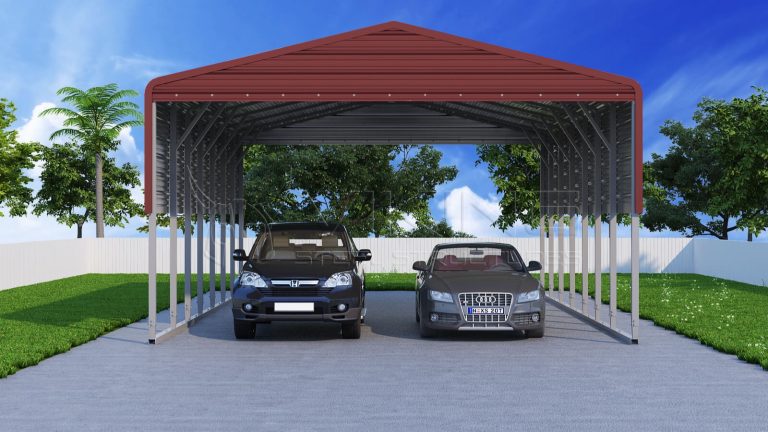
- Double-wide garages (20×20 to 24×26): the most popular RTO category, fitting two vehicles or a vehicle plus equipment. Most American buyers in this category land between $180 and $320 per month.
- Triple-wide garages (26×36 to 32×40): for buyers covering three vehicles, a workshop bay, or vehicle storage plus a hobby space.
- Workshop garages: taller side walls (10–12 feet), reinforced framing, and often insulation packages. Built for buyers who actually work inside the building.
- RV garages: 12–16 foot vertical clearance, longer dimensions (typically 14×36 or 16×40 minimum), and reinforced doors to handle motorhome and travel-trailer storage.
- Commercial garages: large-format buildings used for fleet vehicles, equipment storage, light manufacturing, or service bays.
- Custom metal garages: anything outside standard dimensions — including L-shaped layouts, attached lean-tos, mixed-use buildings, and combination workshop/storage units.
Factors That Affect Your Monthly Rent-To-Own Payment
Two buyers ordering the “same” garage often end up with different monthly payments. The math is driven by several variables you should know about going in.
Garage size. This is the biggest single driver. Doubling the square footage roughly doubles the cost, which roughly doubles the monthly payment.
Steel gauge. 14-gauge framing is standard. Upgrading to 12-gauge adds roughly 8–12% to the price but extends the lifespan in high-wind zones.
Roof style. Regular roof is the cheapest, A-frame (boxed eave) sits in the middle, and vertical roof — required for snow load and recommended for any building over 31 feet long — is the most expensive.
Customizations. Walk-in doors, roll-up garage doors, windows, and additional framed openings each add to the total. A standard 9×7 roll-up door typically adds $300–$450; insulation packages add $1,000–$3,500 depending on coverage.
Insulation and climate features. Reflective foil, fiberglass batts, or spray-foam-ready packages all change pricing. Vapor barriers, gable vents, and ridge vents are smaller line items but add up.
Delivery location. Most providers absorb delivery within their service radius. Beyond that, freight is calculated by mile and can add $300–$1,500.
Certification requirements. Engineer-certified buildings cost more (typically $300–$800 extra) but are required for permits in many counties.
State and local code requirements. Coastal Florida wind ratings, Colorado snow loads, and California seismic requirements all influence the engineering — and the price.
Average Cost of Rent-To-Own Metal Garages in the USA (2026)
Here’s what real buyers are paying for popular configurations right now, with approximate monthly payments for a 48-month RTO term.
| Configuration | Approx. Total Price | Approx. Monthly (48mo RTO) |
|---|---|---|
| 18×21 single-car (regular roof) | $4,995–$6,495 | $129–$169 |
| 20×20 double (vertical roof) | $7,495–$9,495 | $194–$246 |
| 22×26 double + storage (vertical) | $9,995–$12,495 | $259–$324 |
| 24×36 triple/RV (vertical) | $13,495–$16,995 | $349–$441 |
| 30×40 workshop (12-gauge) | $18,995–$23,495 | $493–$609 |
| 40×60 commercial (certified) | $32,995–$42,995 | $855–$1,114 |
NOTE: Pricing varies by zip code, certification needs, and customization. The Viking Steel Structures Rent-To-Own Calculator gives you exact monthly figures based on your actual configuration — so you’re not guessing at ranges.
How the Viking Steel Structures Rent-To-Own Calculator Helps
Most buyers come into the process with a rough budget but no clear idea of what that budget actually buys. The RTO calculator on our Rent-To-Own Metal Garages page solves that in about 60 seconds.
Here’s what it does:
- Estimates monthly payments for any garage configuration in real time, across 24, 36, 48, and 60-month terms.
- Compares term lengths side-by-side so you can see exactly how stretching from 36 to 48 months changes your monthly cost.
- Lets you adjust customizations on the fly — add a roll-up door, change the gauge, switch to a vertical roof — and watch the payment update instantly.
- Removes the guesswork from budgeting. Instead of waiting on a sales rep to call you back with numbers, you see them immediately.
- Speeds up the buying decision. Most buyers who use the calculator move to a finalized order within days, because they already know exactly what fits their budget.
If you’re seriously considering a metal garage, the calculator is the single fastest way to figure out what your real monthly cost will be.
Common Mistakes Buyers Should Avoid
After more than a decade of installing metal garages across America, the same handful of mistakes show up over and over. Here’s how to avoid them.
- Choosing the wrong size: The single most common regret is going too small to save money up front. A 20×20 fits two cars; an 18×20 forces compromises. The extra $20–$40 per month for the right size pays for itself the first time you don’t have to back a vehicle out to access another.
- Ignoring local building codes: Counties differ wildly. Some require permits for any structure over 100 sq ft; others allow up to 400 sq ft permit-free. Always confirm with your local building department before ordering.
- Skipping certification when you’ll need it: Engineer-certified buildings cost slightly more but are required almost universally for permits. Buying non-certified to save $400 and then needing to retrofit (or replace) costs far more.
- Failing to plan for future expansion: If you might add a workshop, lean-to, or second bay later, build a garage that can accept it. Adding extensions to undersized buildings is harder than starting bigger.
- Comparing only by price: A cheap garage with no warranty, thin gauge steel, and no certification is no bargain. Compare warranty terms, gauge specs, and engineering certifications alongside the sticker price.
- Underestimating the foundation: Concrete pads cost extra but make installation cleaner and structures last longer. If you’re going gravel or dirt, make sure the site is level and well-drained.
Why Metal Garages Are a Smart Long-Term Investment
A steel garage isn’t just a place to park — it’s a property improvement that returns value in several measurable ways.
Durability. A properly installed metal garage with G90 galvanized framing lasts 30–50 years with minimal maintenance. Wood structures begin requiring serious upkeep within 10–15 years.
Low maintenance. No staining, no sealing, no rot, no termites. An occasional wash and the occasional check on anchoring is essentially the entire maintenance schedule.
Weather resistance. Engineered steel structures are rated for wind speeds up to 180 mph and snow loads up to 90 psf when built to spec. Tornado, hail, and wildfire risks are dramatically reduced compared to wood-frame alternatives.
Property value. Permanent steel garages add resale value, particularly in rural and suburban markets where buyers actively look for outbuildings, workshops, and equipment storage.
Insurance benefits. Many homeowner insurance carriers offer better rates for vehicles parked in covered structures, and certified steel buildings often carry better building-specific premiums than wood.
Flexibility of use. Today’s two-car garage becomes tomorrow’s workshop, hobby space, home gym, or rental storage. Steel buildings adapt to changing needs without structural compromise.
State-by-State Considerations for Rent-To-Own Metal Garages
Every state has its own quirks. Here are the most common ones we see across our service area.
- Florida, Louisiana, and the Gulf Coast — High wind ratings (140–180 mph) are essentially mandatory. Certification is non-negotiable.
- Colorado, Utah, and the Mountain West — Snow loads of 40–90 psf require vertical roofs and often heavier gauge framing.
- Texas, Oklahoma, and the Plains — Tornado-resistant anchoring and 12-gauge framing are popular upgrades; large rural lots support oversize buildings.
- California — Seismic engineering and stricter permitting; expect more paperwork than average.
- New York, Pennsylvania, and the Northeast — Suburban setbacks and historic-district restrictions can affect siting; permits are typically required.
- Carolinas, Georgia, and the Southeast — Coastal wind ratings near the shore; humidity makes galvanization quality especially important.
A reputable supplier will know the requirements for your zip code before you do. If they don’t, that’s your signal to look elsewhere.
Frequently Asked Questions
1. Do rent-to-own metal garages require a credit check?
Most rent-to-own programs, including Viking’s, do not require a traditional credit check. Approval is based on identity verification and the property where the garage will be installed, not your credit score.
2. Can I pay off my metal garage early?
Yes. Most RTO agreements allow early payoff at any time, often with a discount applied to the remaining lease payments. There are no prepayment penalties on Viking’s program.
3. Are rent-to-own metal garages available in all 50 states?
RTO programs are widely available across the lower 48 states. Availability and exact terms can vary by state due to local lease and consumer-protection regulations. We’ll confirm program availability for your zip code when you request a quote.
4. How much down payment is required?
Typically only the first month’s payment plus applicable tax. There’s no traditional 10–20% down payment like you’d see on a bank-financed building.
5. What happens if I miss a payment?
Programs vary, but most allow a short grace period and offer rescheduling options. Repeated missed payments can lead to repossession of the building. Always communicate with your RTO provider proactively if you anticipate a missed payment.
6. Can I customize my rent-to-own garage?
Yes. Size, color, roof style, doors, windows, insulation, and certification are all customizable, and pricing adjusts accordingly. Customization options are identical to those available on cash-purchased buildings.
7. Are permits required for a rent-to-own metal garage?
This is governed by your county and city, not by the financing method. Many rural areas allow buildings under specific size thresholds without permits, while suburban and urban areas usually require them. We provide engineering drawings to support permit applications.
8. How long does it take to receive my garage after I order?
Most installations occur within 2–6 weeks of order, depending on regional demand and the specifics of your build.
9. Can I move my garage if I sell my home?
Bolt-together steel garages can be disassembled and relocated, though it requires professional crews. If your RTO is still active, the lease must be settled or transferred before a move.
10. Is rent-to-own more expensive than paying cash?
Yes — slightly. The convenience of no credit check, no down payment, and same-day approval is reflected in a moderately higher total cost over the term. For buyers who don’t have $10,000+ in cash, that tradeoff is overwhelmingly worth it.
11. Can I get a rent-to-own metal garage with bad credit?
Yes. Because most programs don’t run a traditional credit check, bad credit is rarely a barrier. Your eligibility is based primarily on identity verification and your property’s suitability for installation.
12. What’s the cheapest way to buy a metal garage?
Paying cash is always the lowest-total-cost option. If cash isn’t realistic, rent-to-own with the shortest term you can comfortably afford is the next best option, since shorter terms mean less total interest equivalent over the life of the agreement.
Over To You
Rent-to-own metal garages have become the most accessible way for everyday Americans to put a serious, durable structure on their property without draining savings or jumping through bank hoops. You get the garage immediately, you pay in monthly installments you can plan around, and at the end of the term, the building is fully yours — no balloon payments, no surprises.
The combination of no credit check, low initial payment, fast approval, and full customization means RTO works for nearly every buyer scenario, from a homeowner protecting two daily drivers to a farmer covering a tractor and hay equipment to a small-business owner expanding fleet storage.
Built once. Built right. Paid monthly.
Looking for a metal building that fits your needs?
