How the Modern Metal Building Industry Actually Works (From Steel Coil to Final Installation)
 Published On:
 Most people think a metal building is just “manufactured somewhere and delivered.” In reality, it’s the result of a tightly coordinated industrial process involving steel mills, structural engineers, CNC machines, logistics planners, certified erection crews, and the list is long.
Modern pre-engineered metal buildings (PEMBs) are not basic sheds. They are precision-engineered systems. Every bolt hole, every frame angle, and every panel profile is calculated before fabrication even begins.
Let’s follow the full journey.
Stage 1 – Where It All Begins: Steel Production and Coil Processing
How Raw Steel Is Actually Made
Everything starts at the steel mill.
Iron ore is processed in a blast furnace where it is converted into molten iron. That molten iron is refined into steel and cast into large slabs. These slabs are then hot-rolled into long flat sheets. It is later processed further depending on its use. But engineers need clear specifications before they start shaping steel or taking any step. With the help of a 3D metal building designer, you can easily see how building specifications are decided before actual construction begins in a factory.
According to the World Steel Association, global crude steel production exceeded 1.8 billion tonnes in 2023, making steel one of the most widely produced industrial materials in the world. This massive scale allows metal building manufacturers to source consistent, standardized material.
Why Metal Buildings Use High-Strength Steel Coils
Most structural metal buildings use high-strength steel grades such as ASTM A36 or ASTM A572. The difference between these grades lies in yield strength.
For example:
- 36 ksi steel yields at 36,000 psi.
- 50 ksi steel yields at 50,000 psi.
Higher yield strength allows engineers to design lighter structural members without sacrificing load capacity. This reduces overall steel usage and shipping weight.
Most wall and roof panels are made from cold-formed galvanized steel coils. Galvanization means coating the steel with zinc to prevent corrosion. You will often see terms like:
- G60 (0.60 oz zinc per square foot)
- G90 (0.90 oz zinc per square foot)
The thicker the zinc layer, the better the corrosion resistance, especially in humid or coastal regions.
The Role of Coil Coating and Paint Systems:
Color-coated panels are not just painted casually. They undergo a controlled coil-coating process.
Two common paint systems are:
- SMP (Silicone Modified Polyester)
- PVDF (Polyvinylidene Fluoride)
PVDF coatings are more resistant to fading and chalking and are often used in commercial projects requiring long-term color stability. Many manufacturers offer warranties ranging from 20 to 40 years, depending on the coating system.
At this stage, steel exists as high-quality coated coils. But it is still just raw material. So how does this become a building?
Stage 2 – Engineering and Design Before Fabrication Starts
Pre-Engineered Building (PEB) Concept Explained
A pre-engineered building is not pre-built. It is pre-designed. Unlike conventional steel construction, where every beam may be standardized and cut on-site, PEMBs are custom-engineered based on:
- Site location
- Local wind speed
- Snow loads
- Seismic zone
- Intended building use
Every structural component is optimized. The frames are often tapered, thicker where stress is high, and thinner where stress reduces. This saves steel without compromising safety.
Load Calculations That Most Buyers Never See
Before fabrication, engineers calculate multiple loads:
- Dead load (weight of the building itself)
- Live load (people, equipment)
- Wind load (based on regional wind speed maps)
- Snow load
- Seismic load
- Collateral load (HVAC units, sprinklers)
According to FEMA reports, a significant percentage of structural failures during hurricanes are linked to improper wind load calculations or poor connections. This is why modern metal buildings strictly follow standards like ASCE 7 for load calculations. These calculations are not guesswork. They determine every bolt size and weld length.
Software and Automation in Modern Metal Design
Modern metal buildings are designed using 3D modeling software and BIM (Building Information Modeling). Once the design is finalized, the software generates CNC-ready data.
This data is sent directly to fabrication machines. Human error is minimized because machines cut and drill based on digital instructions, not manual measurement. Only after this digital approval does physical fabrication begin.
Stage 3 – Fabrication: Turning Coils into Structural Components

Roll Forming Machines – The Backbone of Panel Production
Roof and wall panels are produced through continuous roll-forming lines. A flat steel coil passes through multiple rollers. Each roller slightly bends the sheet until the final corrugated or ribbed profile is formed. The speed is impressive.
Some lines can produce panels at 100+ feet per minute while maintaining strict thickness tolerances. This profiling increases strength without increasing thickness, a simple but powerful engineering concept.
Primary vs Secondary Framing
Metal buildings consist of two main structural systems, primary and secondary.
Primary framing includes:
- Rigid frames
- Columns
- Rafters
These are often built from welded plate sections. Many are tapered, meaning the depth changes along their length to match bending forces.
Secondary framing includes:
- Purlins (roof support members)
- Girts (wall support members)
- Eave struts
These are usually cold-formed Z or C sections, lightweight but structurally efficient. This division between primary and secondary framing allows efficient load distribution.
Welding, Cutting, and CNC Automation
Structural plates are cut using CNC plasma or laser cutting machines. Bolt holes are drilled with extreme precision. Robotic welding systems ensure consistent weld penetration and quality. Even slight misalignment in bolt holes can delay erection on site.
According to industry studies on prefabrication in construction, off-site fabrication can reduce on-site labor time by 30% to 50%, which is one reason metal buildings are erected faster than conventional systems. But before shipping, quality checks come first.
Stage 4 – Quality Control and Packaging
Factory Inspections and Tolerances
Every structural member is inspected for dimensional accuracy, bolt hole alignment, weld integrity, and coating thickness. Galvanized coatings are sometimes tested using magnetic thickness gauges to ensure zinc layer consistency.
Labeling and Kitting Systems
Each component is labeled with identification numbers corresponding to erection drawings. This is not random packing. It is a kitting system. Organized packaging reduces confusion at the job site and speeds up installation significantly. Once packed, the building is ready for transport.
Stage 5 – Logistics: Moving a Building Across States
Now comes the load planning and transportation. Structural components are loaded onto flatbed trailers with weight distribution carefully calculated. Oversized loads require special permits and route planning. Steel price volatility also affects supply chains. In recent years, global steel prices have fluctuated dramatically due to supply disruptions and demand surges, impacting project timelines and budgets.
Efficient manufacturers plan procurement months in advance to reduce this risk. The truck finally arrives on site. But installation cannot begin immediately; it needs site preparation.
Stage 6 – Site Preparation Before Erection Begins
- Foundation Engineering: Anchor bolts are embedded into concrete foundations before steel arrives. Bolt placement accuracy is critical. Even small misalignment can create major erection challenges. Concrete must reach adequate curing strength before frame installation begins.
- Soil Testing and Load Bearing Capacity: Before foundation design, soil testing determines bearing capacity. Ignoring soil conditions can cause differential settlement, which affects structural alignment. Many building issues blamed on steel are actually foundation problems. Now comes the most visible stage.
Stage 7 – Erection and Final Installation
- Raising the Primary Frame: Cranes lift columns into position. Rafters are connected at height. Temporary bracing stabilizes the frame until the full structural system is in place. This phase requires skilled crews because safety is critical.
- Installing Secondary Framing and Panels: Purlins and girts are attached next. Roof panels and wall sheets are installed using self-drilling fasteners with neoprene washers to ensure watertight seals. Proper torque control is essential to prevent leaks. Refer to a metal building installation guide for more detailed information so you can be better prepared.
- Insulation and Weatherproofing: Insulation systems may include fiberglass blanket insulation, rigid board insulation, and reflective barriers.
Thermal bridging is a key concept here. Steel conducts heat easily, so proper insulation design prevents energy loss.
According to the U.S. Department of Energy, well-insulated commercial buildings can reduce heating and cooling energy use by 20% to 40%, depending on climate and design. This makes the insulation strategy more important than many buyers realize.
Have a look at the image below. It shows how a two car garage is installed on site:
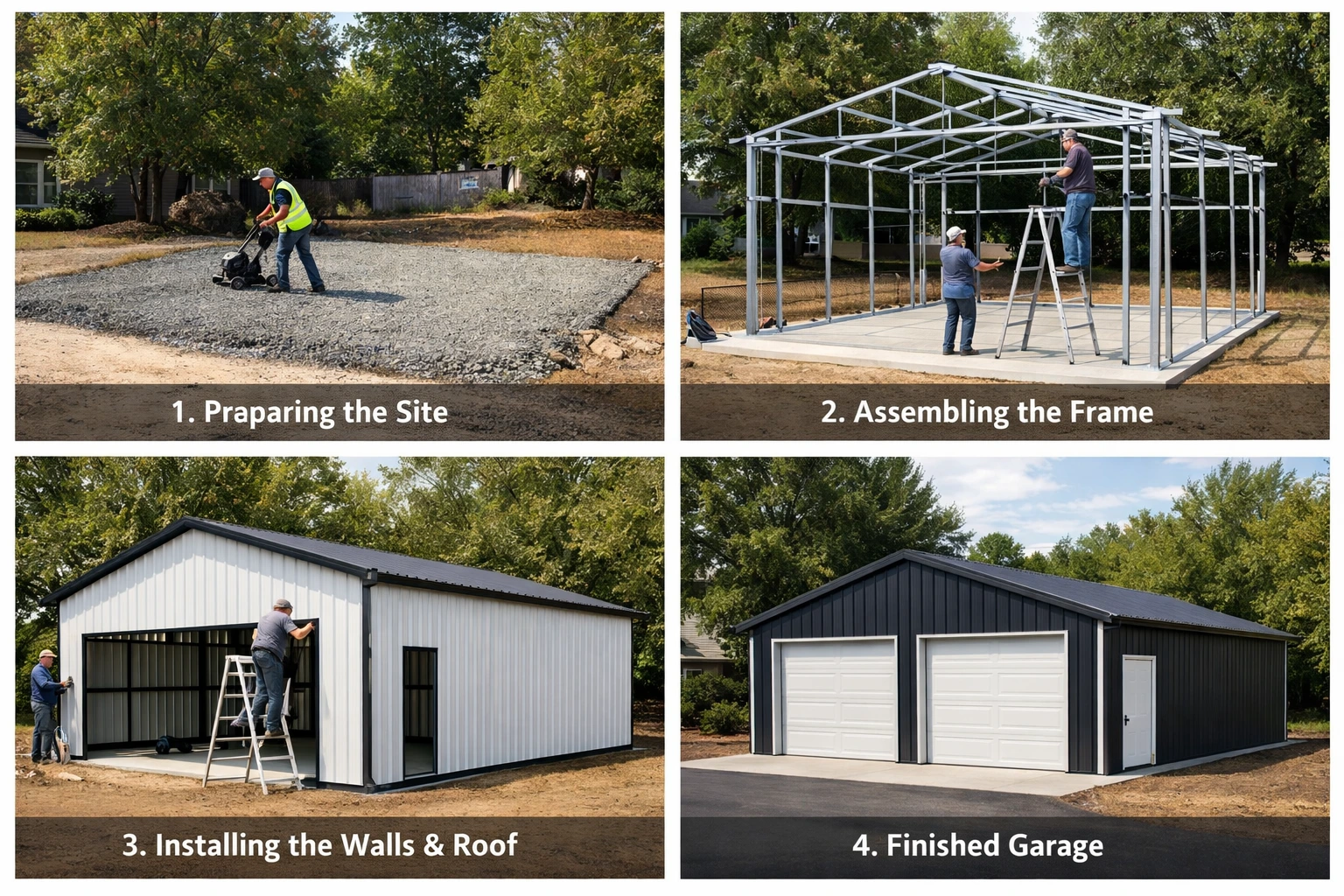
Final Inspection and Handover
Now comes the final inspection to make sure that the product is ready. If it’s ready, it is transported to the site and installed with various tools.
After erection:
- Structural alignment is checked.
- Fasteners are inspected.
- Flashings are sealed.
- Gutters and trims are finalized.
After this, warranty documents are issued, covering structural frames and paint systems. The building is now complete.
Long Story Short:
A modern metal building is not just steel bolted together.
It is the result of:
- Advanced metallurgy
- Precision engineering
- Automated fabrication
- Organized logistics
- Skilled installation
From a massive steel coil at a mill to a fully erected structure on your site, the process is carefully planned at every stage. And once you understand how it actually works, you stop seeing it as “just a shed.” You start seeing it as what it truly is, an engineered system built with industrial precision.
Looking for a metal building that fits your needs?