Vertical vs Horizontal Metal Roofs: Why One Outlasts the Other
 Published On:
 You are comparing two metal roof styles, and you want the one that actually lasts. That is a smart starting point. A roof is not just a cover. It is the first line of defense between your structure and every rainstorm, snowstorm, and scorching summer that rolls through.
And yet, most buyers treat the choice between a vertical and a horizontal metal roof as a minor detail. It is not. Panel orientation quietly determines how long your building lasts, how much maintenance it demands, and whether it stands firm through decades of real weather.
So here is the question this blog answers directly: Does a vertical metal roof really outlast a horizontal one, and if so, why? You will get the full picture here. We look at what happens to water, snow, and debris on each roof style. We look at what the research actually says about steel roof lifespans. We cover the corrosion problem that shortens horizontal roofs faster than most owners expect. And we break down which style is the right choice for which type of building.
Let us start with the basics.
Quick Answer: Vertical metal roofs outlast horizontal ones because panels run ridge to eave, so water, snow, and debris slide off instantly. Horizontal seams trap moisture, causing rust. Vertical roofs last 40 to 60-plus years versus 15 to 30 for horizontal.
What Is a Horizontal Metal Roof?
A horizontal metal roof, also called a regular roof or boxed-eave roof, features steel panels that run side to side across the slope. The panels are parallel to the ground, which makes them straightforward to install and budget-friendly to produce.
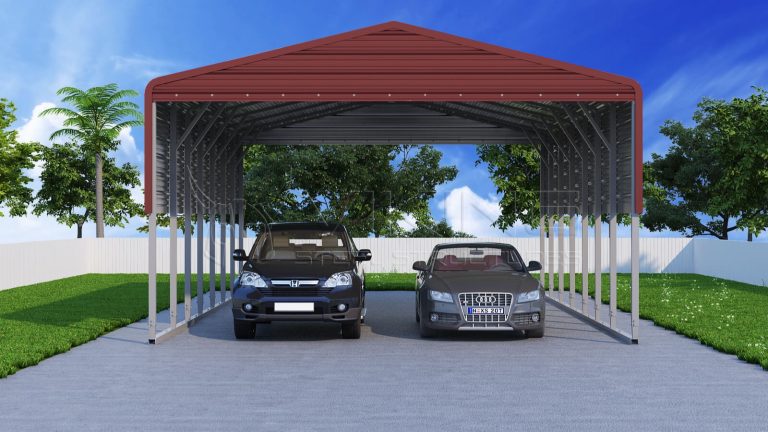
This is the most widely used roof style in the metal building industry. You will find it across basic carports, entry-level barns, and utility sheds all over the country. Regular roof carports are a classic example of where this style fits. The design is practical, affordable, and perfectly adequate for mild climates with low annual rainfall.
The tradeoff shows up when the weather gets serious. Because the panels run horizontally, every seam between panels is a potential resting point for water and debris. In light-weather regions, this is rarely a problem. In any region with real seasonal stress, those seams become a liability over time. The next section explains why.
What Is a Vertical Metal Roof?
A vertical metal roof has steel panels that run from the ridge straight down to the eave. The panels follow the slope of the roof, oriented in the same direction water naturally travels.
To support this orientation, vertical roofs use additional purlins and hat channel supports between the roof frame and the panels. This adds to the upfront installation cost. But it also adds meaningfully to the structural performance of the entire roof system.
You will find vertical roofs on garages, workshops, barns, and any structure where durability takes priority. Vertical roof garages are a popular choice for vehicle and equipment storage in regions with severe seasonal weather, precisely because the ridge-to-eave design handles rain, snow, and wind in ways that a horizontal roof simply cannot match.
The difference sounds subtle. It is not. Let us look at the mechanics.
Panel Orientation Is Where the Durability Story Begins
The entire lifespan gap between vertical and horizontal metal roofs traces back to one thing: what happens when water and debris land on the surface.
On a horizontal roof, the panels run across the slope. Every seam between panels also runs horizontally. That means water has to travel over those seams before it reaches the edge and drains off. In light rain, this is not catastrophic. But in heavy or frequent rainfall, water slows at those seams and sits longer than it should.
Debris makes the situation worse. Leaves, pine needles, dirt, and small branches collect in the horizontal seams and gaps. This organic material holds moisture against the steel surface long after the rain has stopped. That prolonged contact between moisture and steel is where corrosion begins.
On a vertical roof, the panels run from ridge to eave. The seams run vertically, too. Water has a clear, uninterrupted path from peak to edge. There are no horizontal surfaces for moisture to rest on, and no seam edges for debris to catch on. Everything moves off the roof the way it should, continuously and quickly.
One industry professional described vertical roof panels as “gutters that actually work.” That description is simple, but it captures exactly what makes this design so effective over time. The vertical roof does not just handle rain. It actively manages it, guiding every drop off the surface without giving it any place to rest.
This orientation difference is the root cause of nearly every durability advantage a vertical roof holds over a horizontal one. The corrosion resistance, the snow-shedding, and the lower maintenance requirements all trace back to the direction the panels run.
What the Research Says About Steel Roof Lifespans
Steel roofing is one of the most thoroughly studied building materials in modern construction. The data on longevity is consistent, and it comes from highly credible sources.
The Metal Construction Association (MCA) published a service life assessment of low-slope 55% Al-Zn alloy-coated steel standing seam roofs. The study was based on field inspections of 14 real-world roof installations across the United States, some with up to 35 years of active service. The findings were significant.
MCA Study Key Finding: Corrosion rates on vertical standing seam steel panels were so low that projected panel service life ranges from 60 to 375 years for an AZ55 coating, depending on local precipitation chemistry. In all but the worst-case test site, coating life was projected at 79 years or more.
These are not hypothetical numbers. They come from documented field performance on actual structures in real environments across multiple climate zones in the United States.
MBCI, one of the leading metal roofing panel manufacturers in the country, confirms that metal roofing systems offer a lifespan of over 60 years with minimal maintenance requirements. This performance standard is specifically tied to proper drainage design, which vertical panel orientation directly supports.
The Zinc-Aluminum Coaters Association has separately confirmed through its own studies on standing seam roofs that Galvalume-coated steel, when properly installed, can be expected to last the full service life of the building itself. In other words, the roof and the building it covers age out together, not sequentially.
For comparison, a standard horizontal regular roof in moderate conditions typically performs well for 20 to 30 years before needing significant maintenance or panel replacement. In humid climates or regions with heavy seasonal rainfall and snowfall, that number often drops to 15 to 20 years without consistent upkeep.
The research-backed lifespan gap between vertical and horizontal metal roofs is real, measurable, and consistently documented.
The Rust and Corrosion Problem: How Horizontal Roofs Age Faster
Corrosion on a metal roof follows a predictable chain. Understanding it makes the durability difference between vertical and horizontal roofs very concrete.
Here is the sequence on a horizontal roof. Water lands on the surface and travels across the panels toward the seams. At each horizontal seam, moisture slows. Debris that has settled in the seam holds that moisture in place after the rest of the roof has dried. The protective coating on the steel, whether it is Galvalume, galvanized steel, or a painted finish, begins to break down at those stress points through repeated wet-dry cycles.
Once the coating is compromised, even slightly, oxidation begins. Red rust appears at the seam. What started as a small area of trapped moisture becomes an active corrosion site. From there, the damage spreads along the seam. A single compromised section can eventually allow water to penetrate beneath the panel, leading to leaks and structural damage in the building below.
On a vertical roof, this chain is interrupted at the very first link. There are no horizontal seams where moisture lingers. The protective coating faces far less localized stress. Because the surface dries faster and more completely after each rain event, the conditions that start the corrosion process simply do not develop at the same rate.
This is why metal building owners in humid climates, and those whose properties are surrounded by heavy tree coverage, are consistently directed toward vertical roof styles. In one documented case from a property surrounded by pine trees, a vertical roof installation kept the roof surface clean and dry after two years of constant tree litter, requiring virtually no maintenance. A horizontal roof in that same environment would have collected debris in every seam, holding moisture against the steel for weeks at a time.
How Water, Snow, and Debris Behave on Each Roof Style
The weather is relentless. Even in mild climates, a roof faces thousands of rainfall events over its lifetime. In harsher regions, add heavy snow loads, ice cycles, wind gusts, and seasonal debris. Here is how each roof style handles those conditions across the board.
| Weather Factor | Horizontal (Regular) Roof | Vertical Roof |
| Water Drainage | Slows at horizontal seams | Fast, gravity-assisted from ridge to eave |
| Snow Shedding | Accumulates on seams, adds dead load | Slides off quickly, eliminates ice dams |
| Debris Accumulation | High, organic matter collects in seams | Low, smooth uninterrupted surface |
| Wind Uplift Resistance | Standard framing | Stronger with additional purlins and hat channels |
| Corrosion Risk | Higher at seam contact points | Lower across the entire surface |
| Maintenance Frequency | More frequent inspections needed | Minimal, near maintenance-free in many climates |
| Long-Term Longevity | 15 to 30 years (climate-dependent) | 40 to 60+ years (research-backed) |
Every row in this table points to the same root cause: panel orientation and how it controls the movement of water, debris, and snow load. Let us now look at how this plays out in real seasonal weather conditions.
Snow, Wind, and Storm Performance: Where the Gap Becomes Critical
For anyone building in a region with serious seasonal weather, the performance difference between these two roof styles becomes especially important, not just for longevity but for structural safety.
Snow load is one of the most critical structural concerns for any roofed structure. On a horizontal roof, snow accumulates more slowly because horizontal seams and panel ridges create friction. That trapped snow continues adding weight to the structure. In heavy snowfall years, this can stress the framing significantly. It also creates conditions for ice dams when daytime thawing and nighttime freezing cycle repeatedly through winter.
On a vertical roof, snow slides off quickly. The smooth ridge-to-eave panels give accumulated snow a clear path to the ground. This keeps dead weight off the structure and eliminates the ice dam risk almost entirely. For lean-to barns built in regions with regular winter snowfall, a vertical roof is not just a durability upgrade. It is a structural safety decision.
Wind uplift is another area where vertical roofs perform differently. The additional purlins and hat channels that support vertical panel installation also add rigidity to the entire roof system. This gives vertical roofs better resistance to wind uplift, which is the force that tries to pull roofing material away from the framing during high-wind events. In regions prone to tropical storms, coastal winds, or open-plains gusts, vertical metal roofs regularly meet stricter wind load inspection standards that horizontal roofs struggle to match without further reinforcement.
One documented real-world example: a 40-by-60 metal building needed to pass strict snow and wind load inspections before construction could proceed. A vertical roof was installed. The structure passed inspection and has since held through multiple severe storm events without any drainage failures or structural issues. That is the kind of performance consistency that makes vertical roofs the default recommendation in serious weather regions.
Real-World Applications: Which Roof Fits Which Building?
The right roof style depends on what you are building, where you are building it, and what you are protecting inside it. Here is how the decision plays out across the most common metal building types.
Carports: A regular roof carport works well in mild, dry climates where the primary goal is basic vehicle coverage and weather is rarely severe. In areas with tree coverage, seasonal rain, or high humidity, the horizontal seams begin collecting debris within the first few years, and the maintenance burden grows steadily from there.
Garages: Garages that store vehicles, tools, and other equipment benefit significantly from a vertical roof. The value of what is stored inside makes the durability case straightforward. A single leak event caused by a corroded seam can damage property worth many times the cost difference between the two roof styles.
Agricultural Barns: Vertical roofing is especially critical for agricultural structures. Carolina barns often house hay, feed, and livestock, all of which are vulnerable to moisture. A horizontal seam that begins leaking does not just create a roof repair bill. It can ruin stored goods and compromise animal health. Vertical panel orientation dramatically reduces that risk by keeping moisture from ever sitting on the surface.
Workshops: Vertical roof metal workshops are the standard recommendation when expensive tools and equipment need year-round protection. In humid climates, even minor water intrusion from horizontal seam failure can damage machinery worth far more than the initial cost difference between the two roof styles.
Lean-to Structures: These add-on buildings often feature lower pitches and tighter drainage profiles, making efficient water-shedding even more important than on a full-span structure. A lean-to barn with a vertical roof in a rainy climate has a genuine long-term advantage that a horizontal roof in the same environment simply cannot provide.
| Building Type | Recommended Roof | Primary Reason |
| Carport, mild dry climate | Horizontal (Regular) | Cost-effective, adequate for low weather stress |
| Carport, humid or wooded area | Vertical | Debris and moisture management at seams |
| Garage with vehicle storage | Vertical | Superior protection for high-value contents |
| Agricultural barn, humid region | Vertical | Prevents moisture damage to stored goods |
| Workshop with equipment | Vertical | Protects machinery from water intrusion |
| Lean-to, heavy rainfall zone | Vertical | Low pitch needs fast, uninterrupted drainage |
| Utility shed, dry climate | Horizontal | Budget option for low-risk environments |
Cost vs. Longevity: The Numbers That Matter Over Time
Vertical roofs cost more upfront. That is a fact, and it is worth being direct about. The additional purlins, hat channels, and more complex installation add roughly 10 to 20 percent to the initial price tag compared to a horizontal roof of the same size.
But the real question is not which roof is cheaper on day one. The real question is which roof costs less over its lifetime.
Here is how that math works out. A horizontal roof on a mid-sized metal building in a challenging climate often needs significant maintenance at the 15-year mark, and possible panel replacement somewhere between years 20 and 25. Those repair costs, added to the original installation, represent a second major roofing expense within a single building’s lifespan.
A vertical roof under the same conditions is projected to run 40 to 60-plus years with only routine maintenance. In a 40-year window, a building owner with a vertical roof may face no major roofing expense beyond the original installation. That is not a minor saving. For a mid-sized commercial or agricultural building, it can represent tens of thousands of dollars.
There is also the hidden cost of roof failure. When a horizontal seam fails, it is not just a panel that needs replacing. It is the moisture damage to framing, insulation, stored goods, and flooring beneath the leak. Those secondary costs are rarely captured in the simple price comparison between roof styles, but they are very real.
| Metric | Horizontal Roof | Vertical Roof |
| Upfront Cost | Lower baseline | 10 to 20% higher |
| Estimated Lifespan, mild climate | 20 to 30 years | 40 to 60+ years |
| Estimated Lifespan, harsh climate | 15 to 20 years | 40 to 60+ years |
| Maintenance Frequency | Higher, seam monitoring needed | Lower, near maintenance-free |
| Seam Corrosion Risk | Higher | Significantly lower |
| Snow and Wind Performance | Standard load ratings | Superior, meets stricter inspections |
| Long-Term Cost of Ownership | Higher (multiple cycles) | Lower (single lifetime investment) |
When you look at the full 40 to 60-year picture, the vertical roof is not the expensive option. It is the cost-effective one.
So, One Roof Wins on Longevity, Every Time
After looking at panel orientation mechanics, drainage performance, documented corrosion research, snow and wind load data, and real-world case studies, the answer is clear and consistent.
A vertical metal roof outlasts a horizontal one in virtually every measurable category. The reason is not branding or marketing. It is physics. Running panels from ridge to eave removes every resting point for water, snow, and debris. That single design feature multiplies the lifespan of the roof and reduces maintenance to a level that horizontal roofs, in any climate with genuine seasonal stress, simply cannot match.
A horizontal roof is not a bad choice. In the right climate, for the right application, with consistent maintenance, it serves its purpose well and at a lower initial cost. But when the goal is longevity, and when the structure is expected to perform for decades without constant upkeep, the vertical roof wins every time.
Whether you are planning a carport, a garage, a barn, or a workshop, take the roof decision seriously. It is not just about what the structure looks like on the first day. It is about what it looks like on year 30, and whether it is still doing its job without costing you more money than you ever planned to spend. Choose vertical where you can, and you will very likely never have to choose again.
Looking for a metal building that fits your needs?